The Difference Between USB Data Cable With E-marker Chip And Without Chip
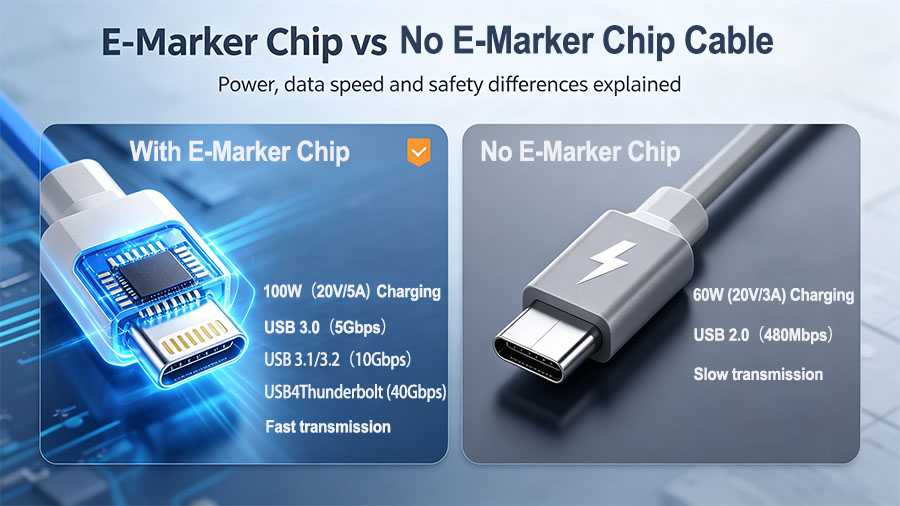
Many buyers and users often confuse USB Type-C cables with and without E-Marker chips when selecting a cable. Although both feature USB Type-C connectors, there are significant differences in power delivery, data transfer capability, and safety performance. Choosing the wrong cable not only prevents fast charging, high-speed data transfer, and video output but also risks overheating and device incompatibility. This article thoroughly explains the differences between the two types from key aspects including core functionality, safety protection, application scenarios, and identification and selection tips, helping readers make accurate choices.
Core function difference
Data cable with E-Marker chip
- The rated current, voltage and other specifications of the cable are stored inside the chip, and the power can be actively negotiated with the charger and terminal equipment, and it supports 20V/5A (100W) and even EPR extended power 240W high-power transmission. ·
- Follow the PD protocol, rely on VDM instructions to report the upper limit of cable carrying capacity to the device, and unlock high-power fast charging.
Chip-free data cable
- Without specification reporting capability, the device will automatically activate the minimum safety standard, which is usually 5V/1A, 5V/2A, and the power limit is generally limited to 60W. ·
- Even with a high-power PD charger, it cannot trigger high-voltage fast charging and force down-power operation.
Data cable with E-Marker chip
- Can support USB3.0 and above, up to 80Gbps bandwidth; Compatible with USB4 Gen4 and DP2.1 protocols to achieve 4K 8K lossless video output. ·
- Ability to mark whether the cable is passive or active, optimizing signal stability over long distances.
Chip-free data cable
- Most of them only support USB2.0 (480Mbps) low-speed transmission, do not support video output, only basic charging, simple data copying. ·
- The type of cable cannot be identified, and the signal attenuation is obvious during long-distance use, and it is easy to lose packets.
Safety protection mechanism
Data cable with E-Marker chip
- Built-in overheating protection, the high-power output will be automatically cut off when the temperature exceeds the threshold to avoid the risk of overheating.
- The withstand voltage of CC and VCONN ports can reach 36V, with over voltage protection; Intelligent current regulation, the output power will not exceed the rated specification of the cable.
- With USB IF certification, the hardware solution complies with the industry's unified security standards.
Chip-free data cable
- There is no onboard temperature and voltage monitoring, and all protection depends on the charging head and the equipment itself. There are protection delays and potential overheating hazards under high loads. ·
- Lack of official standards, uneven products on the market, and inferior wires are prone to damage terminal equipment.
Difference in actual application scenarios
✅ E-Marker chip cable is suitable for: gaming notebooks, high-performance notebooks and other high-power devices above 100W; Industrial handheld devices requiring 240W EPR extended power; The dual-terminal chip solution further guarantees the stability of high-power transmission.
✅ Chipless cables are applicable: mobile phones, ordinary tablets and other low-power devices within 60W, only for basic charging.
✅ E-Marker chip cable is suitable for: large file copying, video editing and other high-speed data services; The external display outputs 4K/8K images; Compatible with Thunderbolt 3/4, docking with professional docking station.
✅ Chip-free cable Applicable: only charging, simple low-speed data synchronization, not suitable for professional high-speed services.
Identification Methods and Practical Suggestions for Purchasing
How to quickly identify
- Physical appearance: The USB Type-C connector with E-Marker chip has more internal space; Chipless connector structure is smaller and simpler.
- Tool detection: With the help of PowerZ and other testers, the cable parameters stored by E-Marker can be directly read; Chipless cables have no parameters to read.
- Wire body printing: Qualified E-Marker cables will clearly mark rated power and transmission rate; The parameters of inferior products are falsely marked or the specifications are not printed at all.
Procurement elements
- In high-power and high-requirement scenarios, double-ended E-Marker chip cables are given priority to ensure two-way recognition compatibility and avoid single-ended chip recognition failure.
- Confirm that the chip supports the USB PD3.1 standard and adapts to the new generation of devices; The older version of the chip will lose some new functions.
- Prioritize wires with USB IF certification to avoid security risks caused by counterfeit chips.
Precautions for use
-
The cost of E-Marker cables is higher, but it can fully release the fast charging and high-speed transmission performance of the device, and some chips support new functions of firmware upgrades and iterations.
-
Chipless cables are cheap, but there is a rigid upper limit for functions, which is suitable for basic ordinary scenarios.
Summary
The E-Marker chip is the key hardware for USB type-c to realize high-power PD fast charging, high-speed data, and video output. Not all USB type-c cables are the same: in pursuit of high-power charging, high-speed transmission, and video output, you must choose a cable with an E-Marker chip in compliance; Only low-power basic charging can be required without chip cables.
Our company provides certified E-Marker chip USB type-c cable with a power cover of 60W 240W and supports high-speed data and video output. The outer quilt material, joint coating, and cable length can be customized. Welcome to contact the engineering team for a selection plan.
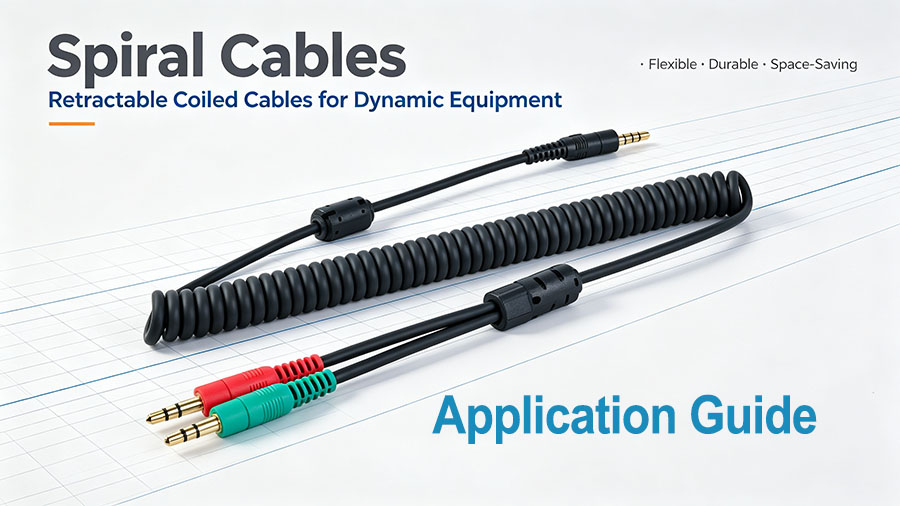
What Are Spiral Cables and Where Are They Commonly Used? Complete Application Guide
Related Article