What Are Spiral Cables and Where Are They Commonly Used? Complete Application Guide
Introduction
In modern electrical and electronic systems, flexibility and space efficiency matter just as much as signal stability and durability. Standard straight cables can easily tangle, stretch, or suffer fatigue damage with frequent movement.Spiral cables—also known as coiled cables or retractable spring cables—are engineered for dynamic, mobile working scenarios. Today, they've become an indispensable wiring solution across residential, commercial, and industrial fields.
This guide breaks down what spiral cables are, their unique structural advantages, and their most widespread applications, helping you understand why more engineers and buyers are choosing spiral cable assemblies for movable equipment.
What Exactly Are Spiral Cables?
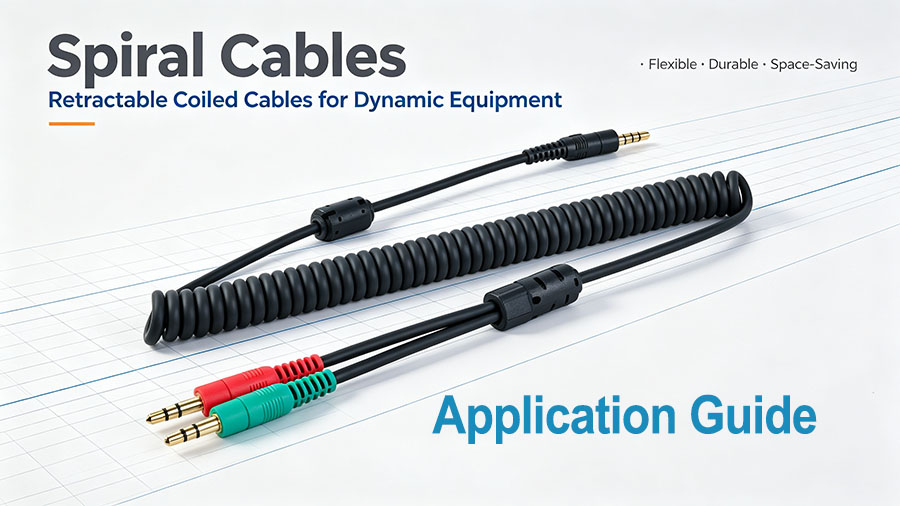
Spiral cables are specialized flexible cables with a unique helical coiled structure. They extend freely when pulled and retract automatically to their original compact shape when released. Most premium spiral cables use high-performance PU or TPE outer sheaths, offering excellent abrasion resistance, oil resistance, and low-temperature flexibility—far exceeding ordinary PVC cables in mechanical durability.
Built to withstand repeated stretching, bending, and retracting cycles, these cables effectively avoid common problems like wire breakage, cable tangling, and messy wiring layouts. They support stable power and signal transmission while saving installation space, making them ideal for all types of frequently moving electrical equipment.
Core Advantages of Spiral Cables
Before exploring specific applications, it's essential to understand the key strengths that make spiral cables irreplaceable in dynamic scenarios:
- Automatic Retraction & Space Saving:The coiled design keeps cables neat and compact when idle, eliminating messy, loose wiring and improving overall site tidiness.
- Superior Flexibility & Fatigue Resistance:Supports thousands of stretching and bending cycles without internal core breakage, adapting to long-term frequent movement.
- Stable Signal & Power Transmission:Custom shielded spiral cable options effectively resist external EMI interference, ensuring consistent signal output for precision equipment.
- Harsh Environment Adaptability:Industrial-grade spiral cables resist oil, abrasion, low temperatures, and UV aging, suitable for indoor, outdoor, and factory harsh working conditions.

Common Applications of Spiral Cables Across Industries
1. Industrial Automation & Robotics
Industrial automation is the largest application scenario for spiral cables. Robotic arms, automated production lines, mobile handling equipment, and industrial handheld control boxes all require cables to move, rotate, and stretch synchronously with mechanical parts. Standard straight cables are prone to aging and breakage after long-term repeated movement, while spiral cables perfectly adapt to dynamic operation, maintaining stable power and signal transmission for automated equipment and reducing equipment downtime.
2. Medical Healthcare Equipment
Medical devices demand high flexibility, safety, and tidiness. Spiral cables are widely used in patient monitors, defibrillators, dental equipment, and mobile diagnostic instruments. Their retractable design prevents cable entanglement and tripping hazards in busy hospital wards and operating rooms, while high-quality non-toxic, wear-resistant materials meet medical safety standards for long-term mobile use.
3. Automotive & Transportation Industry
In the automotive sector, spiral cables serve as core mobile connection components. They are commonly installed in steering wheel clock spring systems, electric seat adjustment structures, sunroofs, and vehicle multimedia movable interfaces. When car parts rotate or stretch, spiral cables follow the movement to ensure continuous and stable power and signal supply for airbags, control buttons, and electronic devices.
4. Commercial & Office Equipment
For commercial and office scenarios, spiral cables are widely applied in retractable power cords, communication equipment, stage audio and video devices, and mobile workstation wiring. Their neat retractable feature keeps office and stage layouts tidy, avoids cable clutter, and is convenient for repeated plugging, moving, and storage, greatly improving space utilization.
5. Testing & Measuring Instruments
Precision testing equipment such as multimeters, oscilloscopes, and portable detection tools requires flexible and durable connecting cables. Spiral test cables can stretch freely according to detection distances, with excellent anti-interference performance, ensuring accurate and stable test data during mobile detection operations.
6. Household & Daily Electrical Appliances
In residential scenarios, spiral cables are commonly used in vacuum cleaners, handheld small appliances, retractable charging cables, and smart home mobile devices. They solve the problem of messy storage of traditional cables, are easy to carry and organize, and balance durability and usability for daily household use.

How to Choose the Right Spiral Cable
Selecting a suitable spiral cable depends on your actual usage scenario. For ordinary household and light commercial use, standard PVC or TPE spiral cables are cost-effective and fully functional. For industrial, medical, and automotive heavy-duty applications, prioritize PU high-wear-resistant, oil-proof, low-temperature-resistant spiral cables, and choose shielded models if signal anti-interference is required. In addition, confirm the stretching length, core number, and wire gauge to match your equipment parameters.
Final Thoughts
From daily household appliances and commercial office equipment to high-precision medical devices and industrial automation systems, spiral cables provide reliable flexible connection solutions for almost all mobile electrical equipment. Their unique retractable structure, excellent durability, and stable transmission performance make them irreplaceable compared with ordinary straight cables.
We offer a full range of customized spiral cables, including different sheath materials, stretching ratios, core specifications, and over-molded connector assemblies, supporting OEM and ODM customization for various industry projects. Contact us to get professional cable selection guidance and bulk quotation.
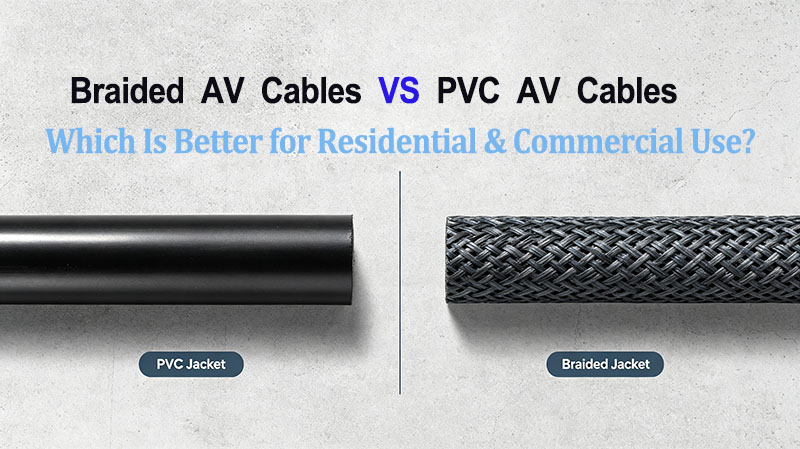
Braided vs PVC AV Cables: Which Is Better for Residential & Commercial Use?
Related Article