What Is the Difference between Gold Plated and Nickel Plated?
When choosing cable joints and connectors, many people will encounter such questions: they are also metal joints, some are shiny, and some are cold-tuned silver-white. What is the real gap between gold plating and nickel plating?
Quick Facts of Core Points
- Gold plating: stable, low resistance, strong anti-oxidation ability,suitable for high-frequency signals, the pursuit of connection reliability is preferred;
- Nickel plating: high cost performance, excellent hardness,used in ordinary working conditions,more suitable for low-frequency signal,cost-first application scenarios.
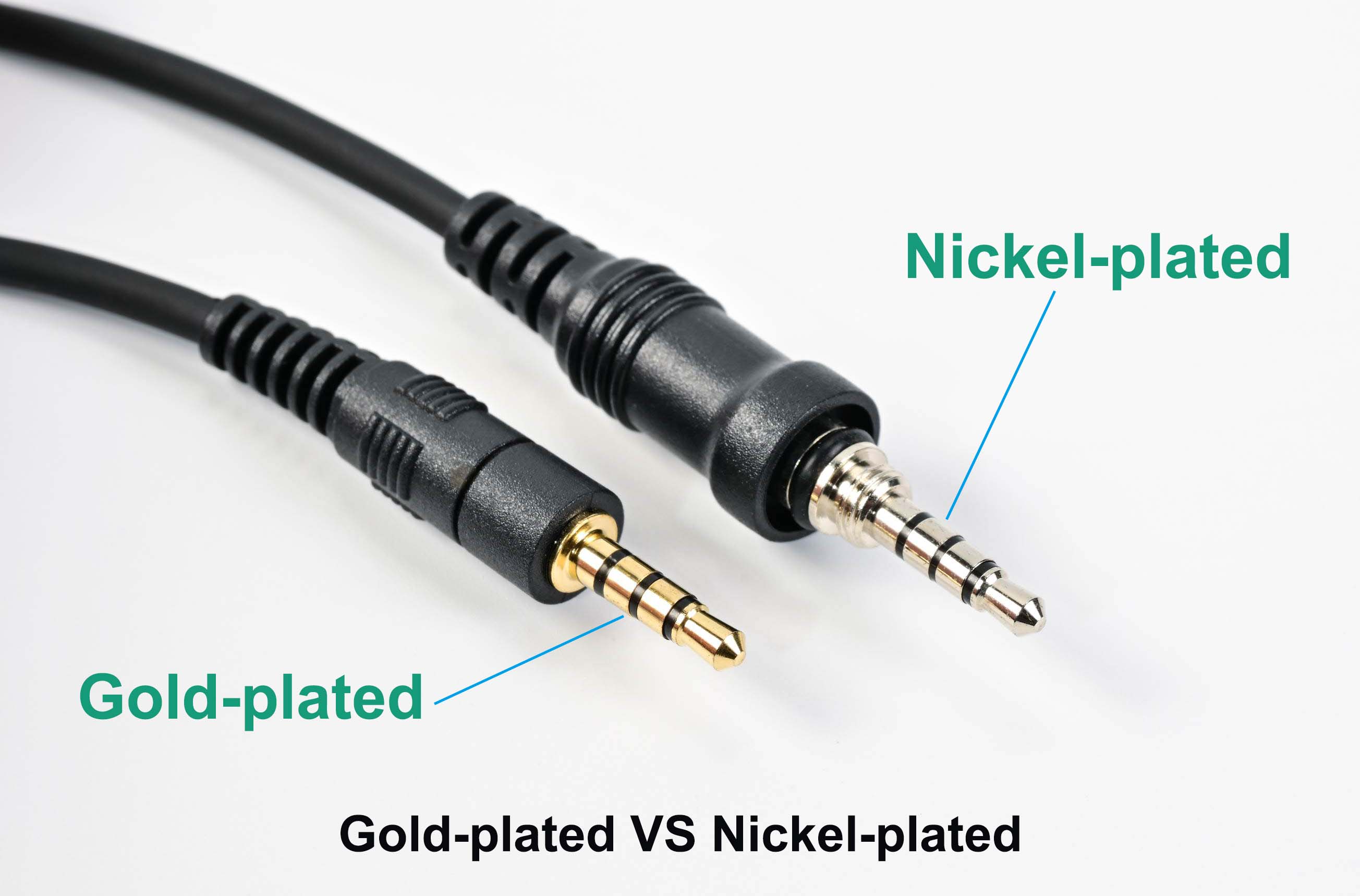
Without professional testing tools, the two joints can be simply distinguished by the appearance color, which is the first judgment basis when purchasing.
- Gold plated joint: It presents a warm and full golden yellow color, with outstanding luster and texture. Even if it is put into use, it is not easy to oxidize and discolor, and the gloss can reach 120 150GU.
- Nickel-plated joints: cold-tuned silver-white, with an overall matte texture. After long-term use, it is prone to yellowing and darkening, and the gloss is in the range of 80 110GU, which focuses on practical attributes.
Simply put, if you value appearance, texture, and long-term durability, gold plating is the better choice; if your needs are basic functionality, nickel plating will be sufficient.
2.Electrical performance: determines signal and operation stability
Electrical performance is the core difference between the two, which directly affects the signal transmission effect, equipment operation stability and product life.
|
Contrast item |
Gold plating (AU) |
Nickel plating (NI) |
|
resistance |
The value is extremely low (≤ 5 15mΩ), the transmission is stable, and the loss is almost negligible |
The resistance is high (≥ 20 50mΩ), which is greatly affected, and the resistance is prone to drift |
|
Anti-oxidation and anti-corrosion |
Almost no oxidation, no corrosion for more than 96 hours of salt spray test, adaptable to bad working conditions |
It is easy to form nickel oxide film and needs regular cleaning and maintenance, otherwise it will affect the effect |
|
Used frequency |
Suitable for high-frequency and high-speed scenarios (0 500MHz), small signal attenuation, smooth transmission |
It is only suitable for low-frequency scenes (≤ 20 kHz), the signal attenuation is serious at high frequencies, and it is easy to distort |
|
Plug-out stability |
After 500 times of plugging and unplugging, the resistance changes by only 5%, and repeated plugging is still stable |
Under the same test conditions, the resistance increase can reach 15 20%, and it is easy to use poorly |
Tips:For scenes that require high signals such as audio, video, and high-speed data, it is recommended to choose gold-plated connectors; Ordinary power supply, low-frequency
signal transmission, nickel plating can be required.
In addition to electrical performance, the hardness of the coating and the life of plugging and unplugging are also very important, especially suitable for equipment that needs to be plugged and unplugged.
- Gold-plated joint: the hardness of the plating layer is medium (HV120 150), the coefficient is small, the plugging and unplugging feel is smooth, and the plugging and unplugging life can reach more than 5000 times. It is suitable for testing instruments and high-frequency plugging and unplugging equipment.
- Nickel-plated joint: the hardness of the coating is higher (HV300 500), and the wear-resistant performance of the body is excellent, but the coefficient is too large, and the plugging and unplugging feel is dry. Use will be accompanied by oxidation, coating wear, joint loosening, failure and other problems.
4. Cost comparison: rational trade-offs in combination with budget Cost is a factor that cannot be ignored in the process of model selection,
and the price gap between the two is relatively obvious.
- Gold-plated joints: the cost is high, and the overall cost is several times that of nickel-plated joints. Even if 0.3 1 μm thin gold coating is used, the price is still higher than that of nickel-plated products, and it is mostly used in working conditions where comprehensive performance is valued and the budget is sufficient.
- Nickel-plated joints: low production cost, suitable for mass production, coating thickness is generally 1 5 μm. At the same time, nickel plating is often used as the underlying substrate of gold plating to improve the overall structural strength, which is a cost-effective basic solution.
5. Coating process: hidden design of high-end joints Many people do not understand that high-quality connectors are not simply single-layer
gold plating, but a composite coating process.
- High-end composite process: copper substrate, nickel-plated substrate, gold-plated surface This is the mainstream process of industrial high-end joints. The nickel bottom layer can prevent copper and gold metals from diffusing each other, improve the overall hardness of the joint, make up for minor defects on the surface of the substrate, and lay the foundation for surface gold plating; The gold plating on the surface is responsible for achieving low resistance, anti-oxidation, ensuring stable signals, and extending product life with double blessings.
- Single-layer nickel plating process: economical basic scheme Electroplating nickel layer directly on the surface of copper substrate has a simple process and low cost. It is mostly used in ordinary power connectors, low-frequency signal equipment, and short-term and basic conductive protection needs.
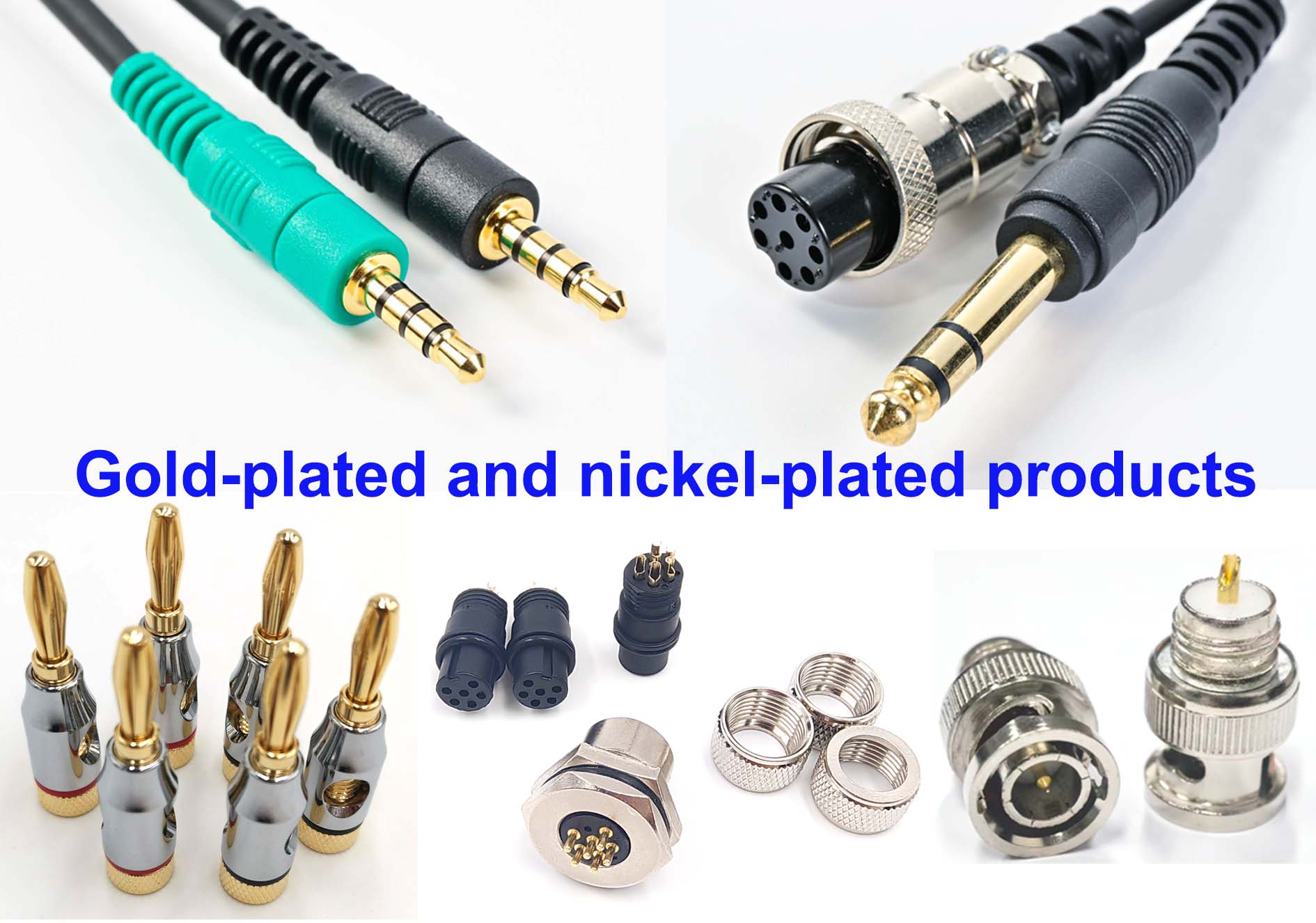
Gold-plated (nickel bottom and gold surface) scenes are preferred:
- HDMI, DP, audio and video and other high-frequency signal transmission equipment;
- Industrial equipment, medical equipment and other equipment that have strict requirements on reliability and life;
- More corrosion, or working conditions that need to be plugged and unplugged;
- Professional audio-visual and testing instruments, equipment with strict standards for signal integrity.
Nickel-plated scenarios are preferred:
- Ordinary power connectors, chargers and low-frequency signal equipment;
- Large-scale procurement,limited budget, no high requirements for performance;
- Ordinary civil equipment with indoor drying and low frequency of plugging and unplugging.
Summary
It is not that gold plating is necessarily better than nickel plating in an all-round way, the core is to match its own actual use scenarios. Gold plating has excellent comprehensive performance and strong stability, which is suitable for high-end, high-frequency and high-reliability use requirements; Nickel plating is economical and practical, with sufficient hardness, and is more suitable for ordinary low-frequency, budget-first scenarios. Most high-end connectors use "nickel bottom layer and gold surface layer" composite coating, which takes into account the two advantages of wear resistance and conductivity.
Our company specializes in the production of all kinds of cables and connectors, which can match the corresponding coating scheme according to your working conditions and signal requirements, so as to escort the stable operation of the equipment.
How to Distinguished USB2.0,USB3.2,USB4.0 Rate and Purchase Guide
A Free CE and RoHS Certificate,Exchanged for Long-term Cooperation
Related Article